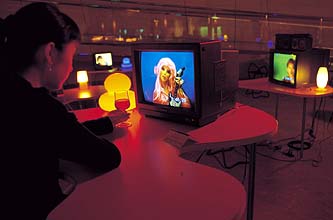
It seems borrowed from William Gibson's cyberpunk novels: an artificial world in which meetings and couplings are facilitated by communications technology. And this is no wonder, for Vilmouth, like Gibson is inspired by the supertechnologized society of Japan. The public space of 'Bar Séduire' exudes the plastic atmosphere of the perfectly orchestrated Japanese bachelor bar in which media have come to play an elementary social role (karaoke, for example). 'Bar Séduire' offers its customers the opportunity of interfacing with mediatised personalities. The customer moves around among small bistro tables surmounted by monitors on which someone is trying very hard to attract a partner. Each table is dedicated to a different type or personality, from the shy young boy to all S&M dominatrix. All seem to be caught up in a kind of overwrought contact video. They look straight into the camera and address themselves directly to their interlocutor. Once the customer has found a personality he finds suitably interesting and attractive he can take a seat at the table. The distance between player and counterpart is such that intimacy is unavoidable. The customer becomes subtly caught up in the game of seduction. He becomes fixated by the intense gaze of the talking heads, their perfect timing of intimate details and signals. The conversation sucks you into itself. "Come closer!" Inevitably, however, the game produces frustration due to the unbridgeable barrier of the medium.
'Bar Séduire' is part of continuing series of projects in which Vilmouth, under the partial inspiration of his location, magically transforms public spaces into a meeting places of lost souls. Involuntarily they become hybrid spaces, closed architecture with medial holes, locked yet open, where the public and the private completely overlap. The obvious model is the Internet café, but the living rooms of our own homes are also saturated with communications technology (TV, cordless phones, internet connections, security systems). Vilmouth's attitude towards these developments, however, is not unreservedly negative. He avoids loud confrontations, relying instead on a strategy of play that makes his work that much more succinct and arresting. He creates environments in which different forms of social and medial interactions exist next to and mixed up with each other. The visitor does not have a point of view imposed upon him, but is simply handed the parameters within which he must determine his own position. In an essay for the catalogue to 'Public: Art: Space' the critic Mel Gooding describes the new public art (projects in public spaces) as "neither authoritative nor comfortably affirmative: it is catalytic" and this certainly seems to apply to Vilmouth's concept-bar . 'Bar de l'Amazone' was one of his first projects in this format: a jungle bar transposed to the European setting of a Paris gallery. The setting and the episodes screened took a rather disported, but also amusing, look at reality. It was a surprising and confusing experience.
There is something strange happening to space and character in 'Bar Séduire' too. This mediabar which is normally speaking a place of social communication and interaction turns familiar ideas inside out. The intimate setting of the bar is disrupted by the laying of a media link leading elsewhere. The television personality is simultaneously present and absent, which gives the relationship an unreal, if not impossible character. There is also no question of real interactions of the kind you expect in a real bar. The one-on-one relation to the screen is also undermined by the open arrangement of the tables. One has the impression of a peepshow that is a little too public. Some personalities play rather archetypal roles, while others seem to display surprisingly honest emotions. The visitor then feels alternately intrigued and embarrassed, attracted and repelled, emotionally affected and estranged. Vilmouth succeeds in simulating a bar where the role of media is played out in an ambiguous manner. The visitor finds out at first hand that the presence of media in the social environment does not always facilitate communication and can lead just as well to frustration and disorder.
– Geert-Jan Strengholt
|
Jean-Luc Vilmouth ° 1952, Creutzwald (France)
Lives and works in Paris (France)
|
|
 1 9 9 9