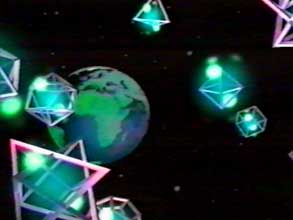
In 1986 Micha Klein was very early with his choice of the computer as the tool of his art. After the standard period of picture-soup experiments that practically every computer artist goes through, he was fairly quick to develop a strikingly personal style which was influenced by the figural language of computer games. The pictorial idiom combines a world of smooth, virtual landscapes populated by smartie-like smiley characters, glowing flowers, bright-red chubby hearts and garishly coloured and cheerful little figures such as Pilman, a dancing pill with big oval eyes, with another, advertising photographer's world of over-the-top, flawlessly finished glossy models. Sometimes he mixes up these two worlds together. Both the atmosphere and sometimes the mode of execution of Klein's work recall the always smiling, always happy work of Jeff Koons. Klein considers it important to show his work on different types of podia: in journals, discothèques and artistic institutions. 'Virtualistic Vibes' (1995), a series of prints in which he assembles photographic images into his virtual world, combining the real world with the digital world, appeared in journals before it was sold by his gallery. However, the photographic models had been so heavily manipulated by the computer that they looked just as artificial as their environment. In 1993 Klein was one of the first Dutch VJs. "I thought galleries and museums were a pretty dozy business. Hardly anyone came to look at my stuff and no one bought a thing. In discothèques you're among 1500 people from your own generation, and you at least get direct feedback. This gives you a forum as an artist which is indispensable if you want to keep your work alive", says Klein. Together with his DJ he chooses a theme in advance which he then prepares in his own studio. At the party venue, or in the discothèque, and according to his own as well as the audience's mood, he selects the image sequences to be performed. In order the better to tune music and image to each other his tapes have soundtracks. He always uses the very latest hardware and software, both for the making of the animations and for their presentation. His latest animations, such as a trio of waving flowers, a grinning sun and a blissfully gazing jack-in-the-box also look like fairly simple comic-strip figures. However, the video rhythms he makes out of them are more complex and hallucinatory than previously. In contrast to his earlier work, when the little figures rocked merrily to and fro against a clearly defined background, and the image was therefore in fact constructed in two layers, there are now many different layers which show through each other, light up, break off, and burst apart in a continual pulsation, rather in the way that the iris of an eye reacts to light: they contract and dilate, contract and dilate. Colourwise too, the images have a greater variety and refinement than before. The effect of the whole is hypnotic, like a stroboscope. The beat accompanying the images is not really essential to their hallucinatory effect; Klein's tapes have quite enough visual beat of their own. The new side to his work is the combination of reality with fiction in his work as VJ. Where he earlier made all the animations himself, he now also combines his computer-generated animations with photographic images such as sky-scrapers and other big-city scenes, though these too are naturally computer-manipulated. And again, it's as though his inner world merges with outer reality to create a great happy-trip event. For his VJ presentation at the World Wide Video Festival Klein has composed these new images together with recycled old motifs into a new mix. Eight projectors throw different images onto the three large screens of his set-up. The audience stands right in the midst of this vibrating, two-hour universal love-happening.
– Ineke Schwartz
|
Micha Klein ° 1964, Harderwijk (Netherlands)
Lives and works in Amsterdam (Netherlands)
|
|
 1 9 9 9