The New York based Dia Arts Foundation has a long standing record of presenting and preserving controversial and ground breaking artists' projects. Since its inception in the late 1970's it has played a vital role among artists and art institutes on a local and international scale. Dia's first major projects were long-term sited works of art not likely to be accommodated by conventional museums because of their nature or scale. Some of the 'ongoing works' projects such as Walter De Maria's 'The Lightning Field' (1977) in New Mexico and 'The New York Earth Room' (1977) and the installations of Donald Judd and John Chamberlain at Marfa, Texas have earned Dia international acclaim and praise. The multidisciplinary nature of Dia's programs includes a collection of works representative of a period that gave rise to Pop art, Minimal and Conceptual art. Its ongoing Readings in the Contemporary Poetry program and the annual Salon Project, which showcases the work of emerging choreographers from all over the world, shows their original commitment to contemporary literature and performing arts. Its main facility, a four-story warehouse in New York, is dedicated to large-scale, long-term exhibitions. Dia began extending its outreach through new electronic media in 1995 when a series of artists' projects were initiated for the World Wide Web. Projects were commissioned to significant artists interested in exploring the aesthetic and conceptual potential of this medium. For most contributors it was their first effort to work with the medium and this sometimes resulted in aesthetically exciting and unexpected contributions. Some of the sites are a little tedious and dull exactly because of this lack of technical experience with the medium. All contributions, dating back to the first in 1995, are posted on the web providing an interesting overview of how things have developed not only technically but also artistically.
|
Francis Alÿs
The Thief |
launch: March 11 ° 1999 |
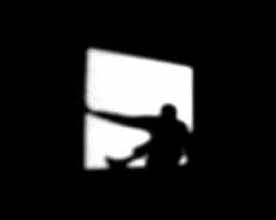
Alÿs has created an animation, available as a screensaver, as his response to the computer and the ubiquitous Windows metaphor. The Thief presents a black field in which a window gradually is revealed, giving on to pure light. Emerging slowly from the dim lit foreground, the shadow of a figure approaches the window and nimbly clambers through. The final moments can also be read in reverse so that the figure seems to fall forward, dropping out of sight into the uncharted depths. The process by which he created this clip has been documented in a series of short arguments where Alÿs investigates the parallels between contemporary interface design and "Alberti's Window", a method of linear perspective drawing encoded and canonized during the early Renaissance.
|
Arturo Herrera
Almost Home |
November 19 ° 1998 |
Herrera's work is known for its exploration of our psychological relationship to narrative. For his project he created a series of 100 collages which are presented as an interactive diptych. The collages combine cartoon imagery with formal elements, creating playful and surprising juxtapositions and associations.
|
Diller + Scofidio
Refresh |
October 1 ° 1998 |
For their first art work for the web, Diller + Scofidio have created a project centered around a dozen live office webcams from around the world. For each location they fabricated a fictional narrative in text and imagery to create an investigation which reflects on the effects of live video on everyday life.
|
Kristin Lucas
Between a Rock and a Hard Drive |
August 13 ° 1998 |
For her project Lucas created a series of waiting rooms for the Internet. For anyone who has experienced chat, this "lullaby for the indiscriminate", as the artist calls it, will ring with familiarity. The rooms are virtual waiting spaces one could visit e.g. while waiting to download the latest version of Microsoft's Explorer. It is the kind of place where boredom and hanging around is all it takes to turn it into a success.
|
Claude Closky
Do you want love or lust? |
December 11 ° 1997 |
Closky presents thousands of questions taken from popular magazines, quizzes, ads, and billboards. While sometimes superficial or absurd, they entertain and enlighten while suggesting the inconclusive and futile tenor of the questions we are confronted with daily. After an hour of answering questions one is still wondering, will I get awarded for my effort or was it just one more way to spend my time?
|
Tim Rollins and K.O.S.
Prometheus Bound |
September 18 ° 1997 |
They have created a series of 'dialogues' which weave together excerpts from 'Aeschylus' classic Greek play, studio discussions, and outside commentary. The outcome is pages or 'scrolls' which, as with all of their work, has been produced collectively. One can imagine what these detailed works would look like in actuality but in the realm of the web where users are bored quite easily and one's monitor is never big enough, there is just simply too much to read and too little to see.
|
Cheryl Donegan
Studio Visit |
March 20 ° 1997 |
Donegan took as her starting point a mainstay of art practice, the studio visit. The viewers are given the opportunity to construct their own version of this codified ritual, albeit as an encounter at a virtual site. It includes a series of drawn and photographed images of Donegan at work in her studio over the course of a day. Opting for 'low-technology' tricks, she creates an interactive experience from a combination of GIF animations, frames, refreshes and mouse-overs.
|
Molissa Fenley
Latitudes |
November 14 ° 1996 |
In 'Latitudes', choreographed specifically for Dia's website, Fenley decided to exploit certain properties of the virtual medium: the greater intimacy between dancer and viewer than is conventionally possible with a stage performance; the opportunity to reverse, repeat, and scrutinize every element of a movement. 'Latitudes', can be experienced in a variety of ways, as well as assembled or deconstructed piece by piece, depending on the viewer's wishes; it can never, however, been seen as a whole.
|
Susan Hiller
Dream Screens |
July 3 ° 1996 |
Hiller is known for her works that explore the margins of consciousness through a variety of media. In this project, Hiller maps her interest in dream states onto the nebulous realm of the web by using interactive colour fields the viewer can click through. With simple yet adequate means she emphasizes the meditative nature of the spoken words on the audio track.
|
Komar and Melamid
The Most Wanted Paintings |
September 5 ° 1995 |
This project attempts to discover what a true "people's" art would look like. Through a professional marketing firm a survey was conducted to determine what Americans prefer in a painting; the results were used to create the paintings "Americans most wanted". This project was expanded at Dia's website, allowing visitors to see the paintings based on completed polls of over a dozen countries and participate directly in a website survey to create a new 'Most Wanted' painting specific to the Internet. It's quite striking to see how astes all over the world are suggested to be similar. That is, of course, the Dutch excluded. They are the only ones that seem to prefer abstract over figurative painting.
|
Tony Oursler / Constance DeJong / Stephen Vitiello
Fantastic Prayers |
March 31 ° 1995 |
|
'Fantastic Prayers' premiered as Dia's first artists' project on the web. The work was originally conceived independently as a plan for a performance. It describes a kind of urban landscape, Arcadia and its residents living in a kind of idyllic suspension that is interrupted only by the intrusion of a figure who represents something of the outside: time, memory, and death. 'Fantastic Prayers' has little of a beginning, middle, or end. It moves around ideas and encounters in a fragmented way which seems analogous to the way one experiences surfing around the Web. |
– Miklós Beyer
|
 1 9 9 9