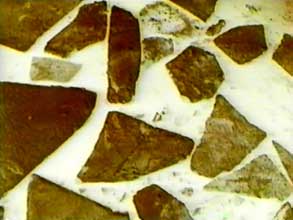
The video consists of two parts: an 'Entweder' part followed by 'Oder'. The first part consists of ice floe like structures, looking for the most part like floating stones, followed by the camera in close-up. The colours are earthly and grubby. The music/sound track steers the camera movements. You follow in a staged dramatic course (the explosive squeak and grunt effects of the music), the quest along interesting details of the floes. Accelerations, decelerations, sudden turns, zooms and pans and colour effects make this, technically, a very clever tape, but you still wonder, after a while, what should be sought in the structures and blotches. It produces a kind of meditation that you can also find in the tachistic paintings of the fifties. Those were paintings consisting of splotches and marks which, seemingly spontaneously, were consigned to the canvas. They were a kind of speechless language signs which were placed in the substrate as primary traces. If you were patient enough, you could look at them for hours and absorb every congealed movement in all its twists and forms. Even with the best of intentions, it was not possible to say anything meaningful about the significance; you had to 'experience' the symbols and let them engrave themselves on your inner self. To be sure, this video does something similar in a time based medium. However, at a given moment, the tape changes. An image of a border post (until then the tape was shot horizontally) with behind it a manipulated image of a river on which you can see fleeting ice floes passing by, marks the second part of the tape. This section, called 'Oder', could be a reference to the river Oder, but it could also be a reference to the masterwork by Kierkegaard. This remains a mystery, for the blotches and structures that you see floating past, reveal as little about the answer to this question in their introverted video dialogue as does the frosty sound track.
– Willem van Weelden
|
Music Luke Blandien, Editing Veit-Lup, Antal Lux
|
|
 1 9 9 7