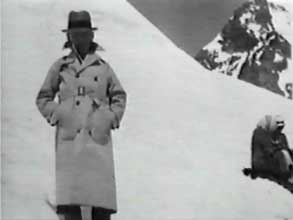
The position occupied by the holocaust in our collective cultural memory is determined by all kind of conventions. Moral agreements which serve as a sort of incantation, the 'correct' interpretation of a number of historical facts which we would not otherwise know how to deal with. Rachel Schreiber has been working for several years with Jewish women, sexuality and its cultural representation; this could previously be seen in works like This is not erotica (1994). In Please kill me... she uses loaded subjects to raise questions about the way in which memories are transmitted and how the importance of historical facts shifts. For some people, recent history plays an important part in their sexual lives, particularly because of the importance now attached to it. Thanks to the anonymity of the Internet, Schreiber could contact sadomasochists with a Nazi fetishism and could ask them what their preferences were and why. The various candid reactions are woven into this video with Schreiber's early memories and photos of her Jewish grandfather during his holiday trip through Germany in 1937. Without making judgements, this video describes a phenomenon that goes much deeper than sadomasochism. A woman cuts off her pubic hair and we flick with Schreiber through the album while a Jewish man tells that Nazi stuff really turns him on because it is taboo. Particularly when he is being terrorized by his Aryan friend, who has Nazi ancestors. Others like Nazi paraphernalia because the authority and power they exude are unsurpassed. Schreiber remembers how she came across a photo of her grandfather at the World Fair in Paris, standing in front of the German pavilion between a flag with a swastika and a monument with an eagle. She realized then with a shock that there had not been a moment in her life when she had not known the meaning of those symbols, while her grandfather had known a time when the swastika meant nothing to him at all.
– Lies Holtrop
|
Editing Mario Paoli, Rachel Schreiber, Music Adonis Tsilimparis, Marlene Dietrich
|
|
 1 9 9 7