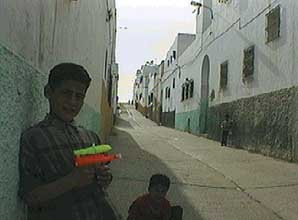
During the first half of 1997, P.A.R.K.4DT interviewed all the present inhabitants of the Eerste van der Helststraat in Amsterdam about the streets where they originally come from. Subsequently, 37 streets in Pakistan, Surinam, Egypt, Israel, Morocco, Malaysia and the Netherlands were recorded on video in static shots of 1 hour. During the World Wide Video Festival, these images will be shown on monitors set up in the windows of the Eerste van der Helststraat. In this way, the Eerste van der Helststraat which is a straight street, will suddenly have 37 imaginary side streets. A virtual skeleton is created - the real street as the backbone and the side streets as ribs - in which you can read the anatomy of the street. And so a side street from a village in Morocco can look out onto a side street from Cairo, or Volendam.
Glenn Omanette, Eriedoriestraat, Paramaribo.
"The street was in a bad way. It was just a dirt track really, not surfaced, about one and a half kilometres long. Water channels left and right, no drains, just an open gutter a metre wide and deep. Fish swam in it. You used to be able to go fishing right from your bedroom window. You could see right through some of the houses. There were great differences between the rich and the poor. That will all have changed now. The street has now been surfaced with asphalt."
Ko van der Meer, Durgerdammerdijk, Durgerdam.
"Durgerdam hasn't changed much," says Ko, "it was a village and it still is a village. Practically no new houses have been built." Ko tells of his youth as if it came from an old fashioned boys book. He was at the village school that was so small that two classes had to be taught at the same time in the same space. Ko wore clogs and, as a boy, he used to sail his boat on the IJsselmeer. He played hide-and-seek with friends on the island of Pampus. He also had fun jumping ditches and looking for eggs.
The Shah family, Satellite Town, E-block, Islamabad, Pakistan.
Satellite Town is a modern suburb of Islamabad. E-block is part of the suburb. The houses are not numbered. We had imagined something quite different. Perhaps more exotic, smaller, more original. But Satellite Town is a new suburb of the disastrous type that makes you think that the influence of East German architects was greater than they temselves could possibly have dared to dream. Grey concrete, purely functional surfaces. “Built to collapse one day.'”
Mr. Otten Sr., Albert Cuypstraat, Amsterdam.
"1955 was a really good time. The market had been surfaced with asphalt for the first time and new drains had been put in. We really had a great party. It's like this: artists were not so expensive then and money was easy to come by, so there were performances by Heintje Davids and Johnny Kraaijkamp and people like that. It was great then. During the day and in the evening too, on two market barrows. Yeah, that was a party!"
Anneke Brouwer, Korte Tolstraat 6-II,-I Amsterdam.
"A lot of Jewish people lived round the corner in the Pieter Aertszstraat. They were taken away. One of my girlfriends lived in that street. Her father was a policeman in the war and there was another policeman who lived a bit further up. They stripped the Jews' houses and put everything into their own houses. I was never allowed to go into at that friend's house. I did play with her, but I wasn't allowed inside. I don't know what happened, but those two ended up in a camp. They were, well I won't say sentenced to death ... but they had been members of the NSB (Dutch Nazis) and they had to go to a punishment camp after the war because they had robbed the houses. My mother told me all about it later."
Mohamed Ahmed El Ibrahimiya, Egypt.
"Ibrahim is my friend in Egypt. Our windows were opposite each other and when we were studying in the evening, we used to talk to each other in sign language. Then he said something like this, and I said something like that. And then we went out onto the street at about 3 or 4 in the morning and we went to the baker's a bit further up to get warm bread with cheese and eggs, to have with a cup of tea. It was only a five minutes walk. Then we went back home to sleep. I often did that with him."
Dov Melo Ha-Hasmonia'im, 33 Queriat Jam, Haifa, Israel.
When the electric fridges came in, the old fridges were put on the street. "There were some accidents then," says Dov. "Children went and hid in them from time to time, but they were very well insulated and you couldn't open them from the inside. We were always being warned not to sit in the fridges. Three children died like that in the settlement. At least, that's what my parents said when they wanted to warn me. In the end, it was decided that old fridges could only be put out without their doors on."
Hussein & Sawkat Basnoe, Noordpoolweg 11, Paramaribo, Surinam.
When Hussein and Sawkat lived there, there were tales that a man who lived right at the back of the street, just before the path turned into jungle, had once murdered somebody. "We never actually saw him clearly, perhaps in the distance. But we were frightened of him," says Hussein. A kind of bogey man then? "Yes, that too. But he really lived there, I know that. But I don't know who he murdered, or why exactly."
Humphry Tjim, Eerste Zijstraat 20, Domburg, Surinam.
The Surinam river plays an important role in his earliest memories of Surinam. He remembers that they always used to swim in its waters. Never had swimming lessons, they taught themselves their own strokes. They always used to swim from sluice to sluice. And at each sluice there were swimming trunks. You could pull the fish out of the water with your hands. And while Humphry is telling all this, he grabs in the air with his hands at the level of his knees and looks very happy.
 1 9 9 7