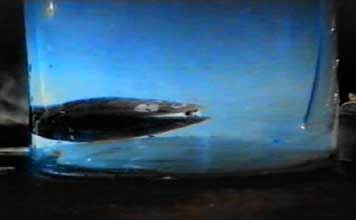
Slowly, the image opens and tells of a woman who leads a secluded, solipsistic existence. Her world consists of, and is shared by mussels which she has collected in huge numbers and with which she identifies herself. They form her existence and fill her thoughts. She cherishes them and everyone of them contains one of her dreams. As long as a mussel lives, it opens and closes, but if the movement stops, or the shell is broken open, the mussel dies. If someone knocks at Julia's door and calls her name, she is startled by what she considers to be an intrusion into her world. Her identification with her mussels goes so far that she also thinks she should die now that she no longer seems to be safe in her withdrawn existence. Her death is her own way of giving herself a new existence. She prepares for her own death and forms a grave in her room in which she will ultimately withdraw to die. But not before she has repaired a mussel's shell and brought it back to life, 'fills' the shell and gives it a name: giving colour to a monochrome existence and transmitting life beyond the moment of her mortality.
– Carla Hoekendijk
|
Light Geert de Bruin, Chris, Camera Bart Reddingius, Sound design Marcus Bogaert, Music Jan Kooper, costumes, rekwisieten Nienke Pol, Musicians Jan Kooper, Daniela Bernoulli, art director Matthijs Müller, With Lesley Hughes, Daniëlle de Boo, Production Ineke van Wierst, Gertjan van Mook, Marcus Bogaert
|
|
 1 9 9 7