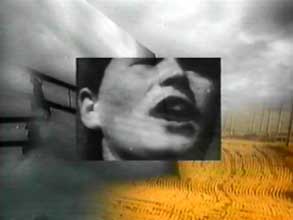
The tape appears to be a loop in which found footage, like existing ideological material, is mixed with apparently randomly shot material of the American landscape. To start with, you see branches, bending heavily under the weight of snow. To the accompaniment of a melancholy saxophone, the camera zooms in on the snow which seems to be stuck to the branches. The picture conjures up the atmosphere of a peaceful nature lyric in which the camera movements and the music form a harmonious whole. Then the camera zooms back and you see that the branches are attached to a tree in a Central Park-like environment. But just when you think you are going to get to see more of the surroundings, the camera zooms in again. Woven through this modest winter imagery are old black and white pictures of bare-chested country workers armed with well-developed muscles and razor-sharp scythes, busily cutting an immense corn field. A grain harvest somewhere in communist Russia at the beginning of the century, for the images have the characteristics of a propaganda film. The industrious and laughing workers have been filmed from below which gives their heroic build even more impact. After a fluid return to the branches, comes a transition to a sober and colourful landscape somewhere in America. After a while, this too is provided with an extra image layer. Once again, you see old material of prairies where Indians on horseback are being chased by white soldiers. But the additions are fragmentary at first, and almost subtle poetic extras. They play, rather, With the visual quality of the images before they present their natural content more explicitly and more clearly. The series of images becomes steadily busier and shows shots from old westerns (High Noon), street demonstrations from the sixties in Paris and more classical early communist propaganda films. An accelerated rhythm arises of both visual and intrinsic dissonants, chance harmonies and sudden transformations, which in their carefully constructed sequence have an associative effect. The concentrated manner in which the found footage is woven into the original material suggests a musical-ideological text in which themes are presented like cultivating the landscape, the eroticizing of film, the cinematographic presentation of heroism, the pathos of the filmed masses and the farce of the pornographic view of women. The old image fragments which set you on this track of thematic interpretation, generally have the appearance of composed mirages which have been added in a subtle contrasting fashion to the hushed, dreamy shots of nature. The text, thus assembled is shanghaied, conned. Somewhere in the middle, as the dramatic opera singing dies away, you hear a recording of a conversation played backwards. You can't hear what is said, but the structure of the sound forms a suggestive link with the images. In this way you could see this 'text' as an entity. A transformed dialogue which provides a nostalgic, critical commentary on everyday and obvious things, exposing themselves in poetic nakedness.
– Willem van Weelden
|
|
|
 1 9 9 7