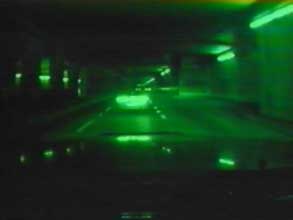
We no longer seem to be fully aware of how many places there are where each one of us is daily being filmed, in the supermarket, at the bus station, in the football stadium and at many other locations. Where is it not happening? But who sees those images and what is done with them? Do you realize that you are being watched, and does this change your behaviour? And what would you not like to be filmed? These are the questions addressed by this video. We see images made with such cameras, combined with stories of people who called a toll free number where they could talk about their experiences, fears and fantasies about video surveillance. Like, for example, the story of the baby sitter who was fired because a recording showed that she sat watching porno films while baby sitting; or the story of a girl who enticed a boy to harass her in front of the camera in the school bus so that she could put a stop to his pestering. Cameras are, however, no longer only used to watch a specific person for specific reasons; everybody is now constantly under suspicion and for those who see the images, it is a question of ‘waiting until something goes wrong’. That, however, also seems to be an attractive aspect and the desire to see this sort of images seems to be a sort of voyeurism, whereby people buy these cameras themselves. As well as the change in the distinction between public and private that this creates, the question also arises of the electronic alter ego and the misleading of such syvoices. And thus also the question as to whether the image shows what actually happens.
– Carla Hoekendijk
|
Camera Tran T. Kim-Trang, Karl Mihail, Thanks to Laura H.Marks, Heather Lockie, Huan Cassiopi-Tran
|
|
 1 9 9 7