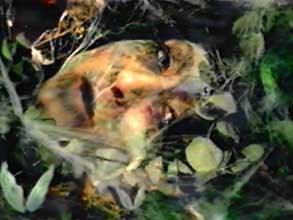
The fragmentary musical composition is the basis for this video that largely consists of a sung monologue performed by a soprano. The story alludes to MedUSA from Greek mythology. According to Ovidius, MedUSA and Poseidon once slept together in one of the temples of the goddess Athena. Athena punished MedUSA by changing her into a winged monster. She turned her hair into snakes and gave her staring eyes: a look from her would turn men into stone. The same Athena helped Perseus to behead MedUSA; she warned him never to look at MedUSA directly, but only at her reflection, and she gave him a highly polished shield with which to protect himself. He takes the head with him, but even in a beheaded state, MedUSA's look maintains its power. The story is told here from (the beheaded) MedUSA's point of view. She is bent on catching the eye of the viewer and does this at first by attracting attention through sound which causes the viewer to stop. She serenades herself as a monster that can be viewed in a mirror (i.e. still harmless) but seduces her viewers to listen to her and to consider her tale in which she cynically characterizes herself as 'mature, independent, headstrong woman seeks man for longterm relationship; must have own shield'. By this time, the viewer will probably have looked at her; the theme repeats as MedUSA continues on her way looking for new victims. The image can therefore disappear and, while the music slowly fades, the viewer is left to suspend his own quietening/petrification.
– Carla Hoekendijk
|
Scenario Chris Aronsten, Andrée Greenwell, Camera Anthony Jennings, Editing Reva Childs, Music Andrée Greenwell, Make-up Katherine Brown, special effects Paul Butler, singereres Helen Noonan, Production Warwick Clarke, Laura Bozanick/Australian Film, Television & Radio School
|
|
 1 9 9 7