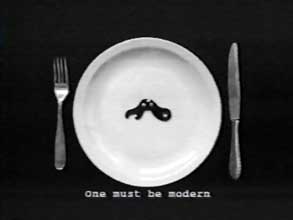
What happens if you read a poem (aloud)? You demand attention for a text. According to Carlos Essman, it is not possible to create an illustration for poetry using moving images. This video, made to accompany the works of the Argentinean poet D.G. Helder, is therefore an illustration of this proposition. The static images only flow from a can of sardines to a board, and the can is opened in a series of images and the sardines eaten. Subsequently, the image changes into a volume meter to show a sequence at the end of the tape involving a tea cup, a watch and then an egg. These are the images in this tape whereby the voice (the text) and the subtitles (text again) are given the most attention. The voice-over in Spanish and the English subtitles then become competitors and the attention has to be shared between image and sound. The text itself evokes a multitude of images, whereby the attention actually has to be divided between listening, reading and the images evoked. And the images of the tape are then added to that. By setting the text in prime position (but which text: the spoken text or the written text?) all other aspects (image, Sound) can become no more than accessories. If you follow the proposition, that could only be possible if they interfere. The question arises as to whether the makers of books have not already been convinced of this point of view for years.
– Carla Hoekendijk
|
Text D.G. Helder, Editing Mario Pablo Ravez, Voice Luis meme
|
|
 1 9 9 7