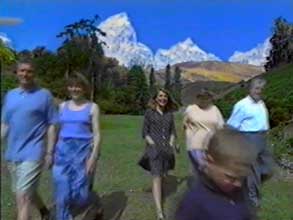
Barber's tapes are based on a clear concept and they often excel in clarity. But appearances can be deceptive, for, however clear the intention and the point of departure may be, everything only leads to alienation and surreal, often grotesque associations. Reality has been lifted up and raised from its often fragile joints. And that is the case here, in which the simple fact of omission leads to alienation. Omission often makes an image less ambiguous. In this case, there seems to be a reversal. You see a group of people, apparently a large family with young and old together, walking down a slope leading to the point where the camera is statically parked. But you have the feeling that the landscape somehow isn't right. It looks like a collection of pieces of picture postcards of the best bits of Central Europe. Even the sound track has clearly been manipulated. Now and then you catch intelligible comments, but everybody is talking at once, and what's more, the wind is also blowing across the microphone. Once all the people have strolled past the camera, a new sequence begins with the same people walking into the same piece of artificial landscape, but this time with subtle omissions. The lushness of the first shot has become more gaunt, even though you can't exactly place the differences. You miss members of the family and nature seems to have been cleaned up. This is repeated a number of times until the gauntness has reached a maximum and the family has been severely thinned out. There are only a few lads left for the last descent. The voices you hear clearly now and then do not make it any easier as far as the reductio ad absurdum is concerned. Now and then a clue is provided when you clearly hear: "You can't comprehend what it is", or when the philosophically inclined lads mutter: "When people die they turn into dust". Then the camera rises from its static forward gaze and moves its lens up to a splendid, peaceful starry sky. In the background you hear the sound of a rattling computer. The digital image processing has withdrawn into an object-less, edited reality in which one can only muse nostalgically in an emptied metaphysic.
– Willem van Weelden |
|
|
 1 9 9 7